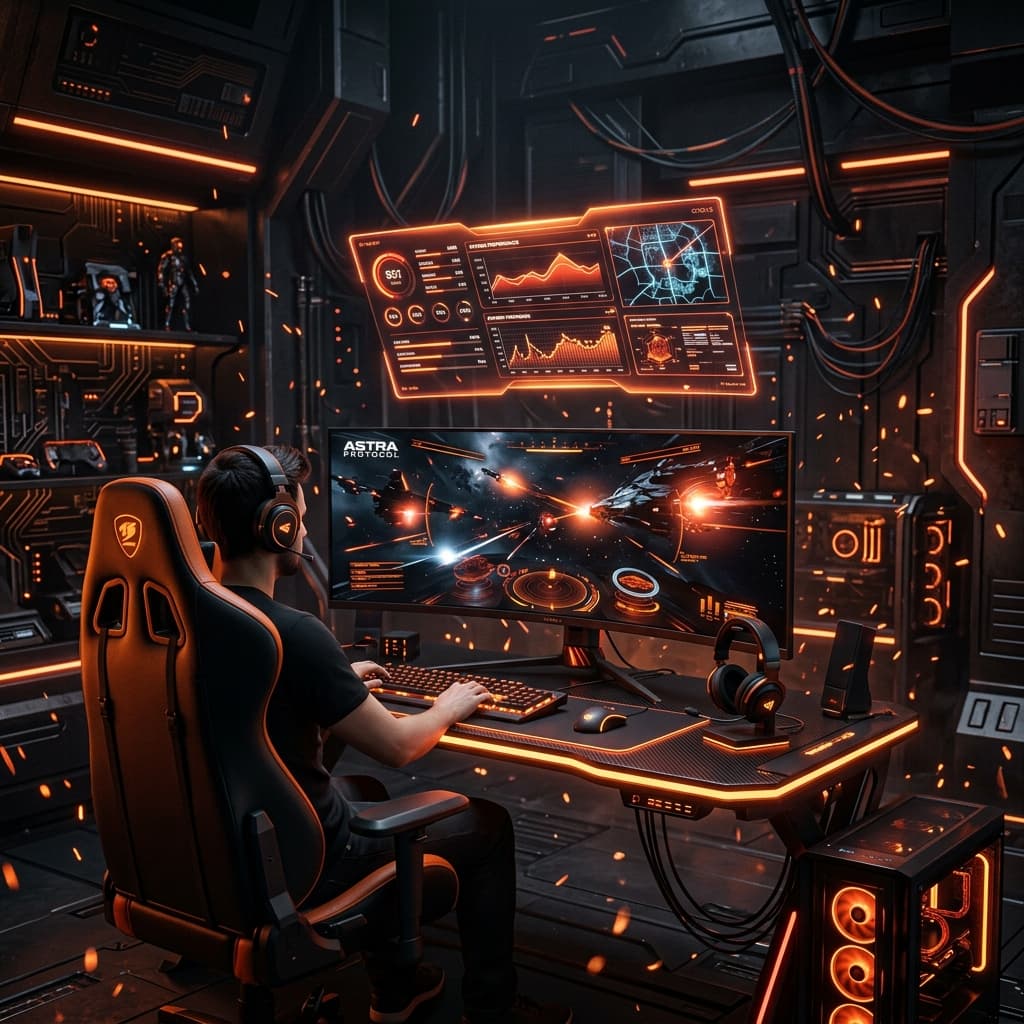
Forging the Next Dimension of Play
At Orange Ember Studios, we don't just build games; we engineer digital presence. Our philosophy is rooted in the belief that true immersion is a synergy of three pillars: Visual Fidelity, Sonic Depth, and Responsive Mechanics.
Using the cutting-edge capabilities of Godot 4.x, we are pushing the boundaries of what indie studios can achieve.
"Immersion isn't an accident; it's a meticulously crafted state of mind."
1. Visual Excellence: The Power of Forward+
Godot 4's Forward+ renderer allows us to implement high-fidelity lighting and particle effects that react dynamically to the environment. We utilize custom shaders to give every object a "weight" in the world, ensuring that graphics aren't just pretty, but purposeful.
Dynamic Interaction via Shaders
Beyond mere aesthetics, our visual effects serve as feedback. A weapon that glows hotter as it fires or an environment that warps with high-intensity magic—these are the details that anchor a player in our universe.
# Godot 4.x - Simple Heat Distortion Shader Controller
extends Sprite3D

@export var heat_intensity: float = 0.0

func _process(delta):
	# Update shader parameter based on game state
	if material_override:
		material_override.set_shader_parameter("distortion_power", heat_intensity)
2. Sonic Depth: Spatial Audio 3D
Sound is 50% of the experience. In Godot 4, we leverage AudioStreamPlayer3D with advanced Doppler effects and attenuation curves to create a soundscape that feels alive. When a player hears a rustle in the grass, they don't just hear a sound—they sense a direction and a distance.
The Impact of Soundscapes
- Occlusion Realism: Using Godot's AudioBuses to dynamically filter sound behind walls.
- Layered SFX: Procedural audio layering to ensure no two sword swings sound identical.
3. Responsive Mechanics: The Flow State
The "feel" of a game—often called juice—is what keeps players coming back. We focus on low-latency input handling and procedural animations to ensure that the character feels like an extension of the player.
Perfecting Game Feel
We use Godot's CharacterBody3D optimized for high-speed movement without losing precision. Here is how we handle fluid motion with responsiveness in mind:
# Godot 4.x - Responsive Character Movement
extends CharacterBody3D

@export var speed = 12.0
@export var acceleration = 8.0

func _physics_process(delta):
	var input_dir = Input.get_vector("ui_left", "ui_right", "ui_up", "ui_down")
	var direction = (transform.basis * Vector3(input_dir.x, 0, input_dir.y)).normalized()

	if direction:
		velocity.x = move_toward(velocity.x, direction.x * speed, acceleration * delta * 10)
		velocity.z = move_toward(velocity.z, direction.z * speed, acceleration * delta * 10)
	else:
		velocity.x = move_toward(velocity.x, 0, acceleration * delta * 5)
		velocity.z = move_toward(velocity.z, 0, acceleration * delta * 5)

	move_and_slide()
The Road Ahead
Our commitment at Orange Ember Studios is to never stop iterating. By combining the flexibility of Godot 4 with our obsession for detail, we are forging experiences that resonate long after the screen goes dark.
Stay tuned as we continue to reveal more about our internal tools and the progress on our upcoming titles.
Live the fire. Join the Ember.